
Factors Driving 220μF MLCC Adoption
Increasing Capacitance Demand around ICs
Higher-performance AD/ADAS ICs require more MLCCs and higher ca pacitance

Severe PCB Space Constraints
ECU integration and miniaturization further limit board space

High Reliability
Requirements
Automotive grade(AEC-Q200), reflow stability, and long lifetime required

Polymer Capacitor Replacement
MLCCs enable downsizing with low ESR and low ESL

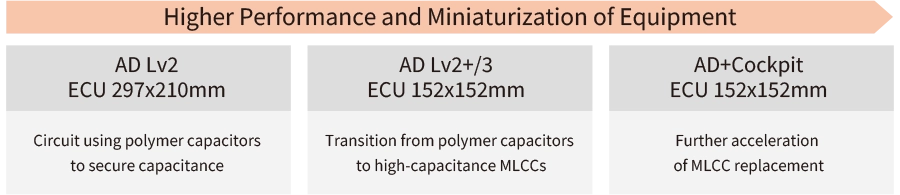
Polymer Capacitor Replacement Leveraging MLCC Advantages
Trend: Replacement from polymer capacitors to MLCCs is accelerating alongside higher SoC performance
High Capacitance Density
Approx. 2×capacitance in the same mounting area
Polymer
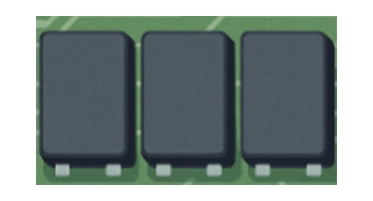
Dcase 7.3x4.3mm 470uF
3pcs 1,410uF
MLCC
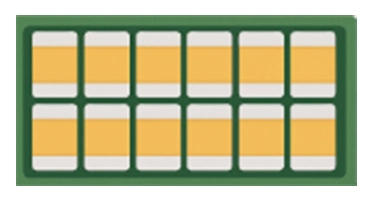
3225(mm) 220uF
12pcs 2,640uF
-
※Design Comparison Example
Low ESR ESL
Noise reduction, ripple and spike suppression
Long Operational Life
Low ESR reduces heat generation caused by ripple current
Product Lineup
Industry-leading automotive MLCC in 4V・3225 size