Smell: A World of Unexplored Potential
Humans experience the outer world through our five senses. Converting them into digital data using cameras for sight, microphones for hearing, and touchpads for feeling has greatly changed lifestyles and industry.
However, among the five senses, smell has proven a difficult field for digitalization and commercialization. Smell is perceived differently according to the individual, and is susceptible to memory and the surrounding environment. Therefore, it is no easy feat to collect and evaluate the information as objective data. However, measuring and distinguishing smell accurately could make possible technologies and services that do not yet exist for detecting abnormalities in the workplace, conducting quality control for food, detecting illnesses at an early stage, and more. This is expected to make human lives safer and more convenient.
TAIYO YUDEN has set its sights on these future prospects, and is working on developing Smell Sensors. How will Smell Sensors be applied as a technology that can supplement or replace the human sense of smell? We spoke with an engineer who believes in their future potential and is pushing forward with development.
Engineer Interviewed
K.S.
Undergraduate School and Major: School of Engineering, Department of Applied Life Systems Engineering
Position in the Company: Development Planning Department, Research and Development Laboratory
Entered the company in 2020. He worked in the Functional Device Development Department, and then assumed his current position in 2023. Since joining the company, he has worked on developing Smell Sensors, and is currently generating new themes and creating systems to support their commercialization.

-
Note:Department names and other information are current as of the time of the interview (August 2026)
Challenges Posed by Smell
If we can practically apply smell sensing, we can detect various signs that occur in living situations as well as in industry. However, humans’ sense of smell often depends on experience and intuition. It is strongly connected to memory and emotion, and there are differences in how individuals perceive it. As such, it’s a difficult matter to quantify.
For example, with taste, there are the five basic flavors of sweet, sour, salty, bitter, and savory. We can evaluate them based on their combinations and relative strengths and weaknesses. In the same way, we are aware of smell when several gas components interact with the olfactory receptors (proteins that react to specific gas components). However, there are about 400 types of olfactory receptors in humans, and 800 in dogs. In fact, the mammal with the most olfactory receptors is the African elephant, which has 2,000 types.*1
Accordingly, there are enormous patterns of the gases that form a smell. Furthermore, there are no common indicators that can be used to systematically evaluate them. All this means that judgement and evaluation of smell are extremely difficult issues.
To deal with this problem, we observed the “smell mechanism of humans.” By combining responses from multiple sensors to understand the overall features of a smell and analyzing that as a pattern, we are developing Smell Sensors that detect quality variations and signs of abnormalities.
-
*1.Source: (2014) Elephants have twice as many olfactory receptor genes as dogs—Genome comparison reveals mammalian diversity
a joint announcement of the Graduate School of Agricultural and Life Sciences, The University of Tokyo, and the Japan Science and Technology Agency
https://www.a.u-tokyo.ac.jp/english/topics_e/topics_2014_e/20140812-1.html
TAIYO YUDEN’s Smell Sensor
An important feature of TAIYO YUDEN’s Smell Sensors is that they do not detect a single gas, but rather can distinguish the type of smell to which they are exposed.
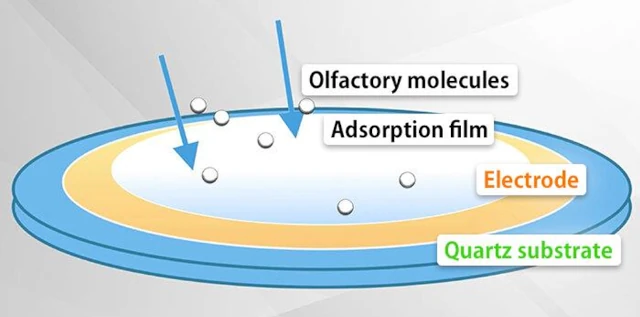
I am developing a type of sensor called a “quartz crystal microbalance.” This device detects smell from the mass variations of olfactory molecules adsorbed on the film of a quartz substrate. Different components are adsorbed more easily by different membranes, so the current model combines 16 different types of membranes to discern the type of smell.
Furthermore, it’s possible to compare the obtained data to already learned smell patterns by using AI in the analysis. It can support making judgements by visualizing the data of smells that previously required human intuition to judge.
The Future of Smell Sensors
Smell Sensors are a technology that turns judgements made by human experience and intuition into data, so they are expected to find more applications going forward.
With the workforce population shrinking and social implementation of digital twins progressing, we expect to see increased demand for their use as a method to quickly detect abnormalities in equipment and quality variations in industries such as manufacturing, logistics, and food production. Also, new applications are surfacing, such as detecting smells that are unpleasant to people, understanding ripeness and quality variations in food, and daily health monitoring.
I think the importance of Smell Sensors will increase in the future in their capacity as a technology that complements the human sense of smell as AI evolves. I hope to focus my abilities on the development and practical use of our company’s sensors so that they can provide solutions for a range of issues faced by society and our customers.