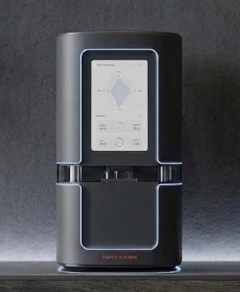
Engineer Interviewed
K.S.
Undergraduate School and Major: School of Engineering, Department of Applied Life Systems Engineering
Position in the Company: Development Planning Department, Research and Development Laboratory
Entered the company in 2020. He worked in the Functional Device Development Department, and then assumed his current position in 2023. Since joining the company, he has worked on developing Smell Sensors, and is currently generating new themes and creating systems to support their commercialization.
-
Note:Department names and other information are current as of the time of the interview (August 2026)
Challenges and Lessons Learned in Smell Sensor Development
A major challenge that we faced was making the sensor evaluations easy to understand. While they have a wide range of applications in the environment, food products, and healthcare, the required performance and operation procedures vary greatly by application.
Therefore, it's important for us to base our thinking not on the technology, but rather on the customer's needs. We’re sorting out who is using the technology in what situation and for what conclusion, and staying aware of providing not merely measurement data, but information that is valuable to users. Individual differences play a large part in drawing a conclusion about a smell. Therefore, we don’t address the question, “What smell is this?” Rather, we propose ways to use the technology for various applications, such as detecting when something is different from the normal state, or deciding if something is similar to an existing pattern or not.
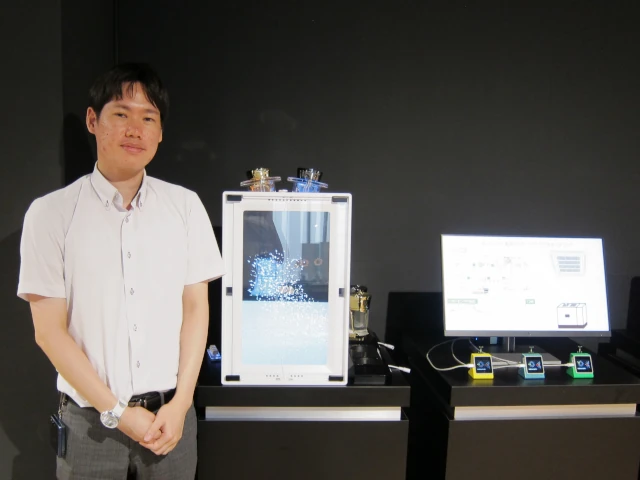
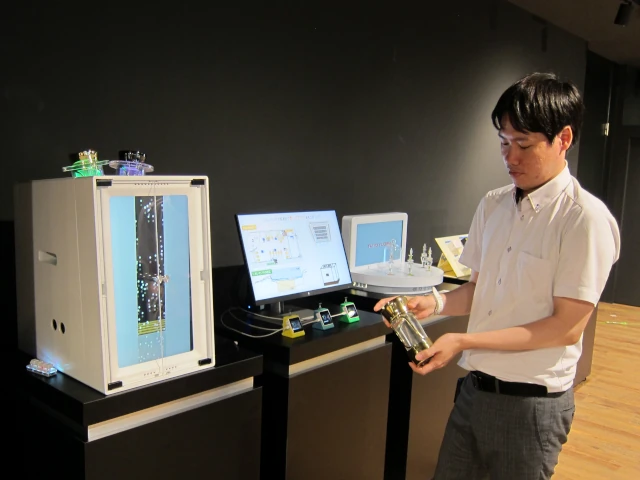
Furthermore, as smell is something that can’t be seen, we had another issue with making the function of the sensor understood intuitively. When displaying our sensors to visitors to our exhibit at CEATEC and CES, we opted not to focus on technical explanations. Instead, we focused on creating an application that visually conveys information on smell.
This experience taught us that commercializing a new technology is not about how perfect the technology is. We learned it’s important to clearly show how it resolves each issue and what kind of value it can deliver. Also, because this is a new domain, we got a first-hand feel for the importance of repeatedly verifying our hypotheses and making improvements while conducting development.
A Sense of Satisfaction as a Developer
In developing the sensor, I feel the greatest satisfaction with being able to take on a new technological domain that is yet to be in wide use around the world. Smell is perceived differently according to the individual, and is susceptible to environment, such as temperature and humidity. That means finding a method to judge and evaluate measurement data is a challenging subject. However, because it is so difficult, I believe that achieving it is of great value to society.
There are many issues that can be resolved through practical use of smell. These include increasing safety by detecting abnormalities in plant equipment, detecting and preventing odors such as halitosis or body odor, and quickly detecting illnesses. Smell Sensors have great potential to contribute to resolving these issues. And that is the driving force that keeps me fully invested in development.
I want to go beyond smell sensors simply being an interesting technology. Going forward, I want them to take form as a technology that resolves the issues being faced by people and society.
The Future of Smell Sensors
In October 2026, we will exhibit at CEATEC 2026, Japan’s largest digital innovation exhibit. We will demonstrate how smell sensors and AI can be used to contribute to the early detection of cancer. This project received the Excellence Award at CEATEC AWARD 2026.
With cancer, patients usually don’t show symptoms in the initial stage. It’s a problem because they often don’t see any reason to undergo a medical examination. We are making a proposal for using our sensors to measure the smell of urine and analyzing the data with AI to quickly measure the risk of cancer as a form of health monitoring, called “preliminary screening.” It’s not a substitute for cancer screenings, but we’re hoping it will be used to detect abnormal signs during everyday life and as a new filter to find those requiring screening by a specialist.
"Early Cancer Detection with AI-powered Smell Sensors"