Ever-Evolving AI Society
Artificial intelligence (AI) has rapidly become widespread in recent years. Its advancement has been accelerated by large language models (LLMs) based on deep learning. Since its introduction in 2022, ChatGPT has enabled increasingly natural interactions that feel almost like conversations between people. Against this backdrop, AI technologies require cutting-edge electronic components that can keep pace with the ever-increasing processing capabilities of semiconductors. TAIYO YUDEN has been developing electronic components related to AI, and in 2025, commercialized an embeddable multilayer ceramic capacitor (MLCC) for AI servers with the world’s highest-ever capacitance*1. We interviewed three engineers engaged in its development and market expansion to learn more about these embeddable MLCCs.
-
Note 1:Based on TAIYO YUDEN’s research as of March 2026.
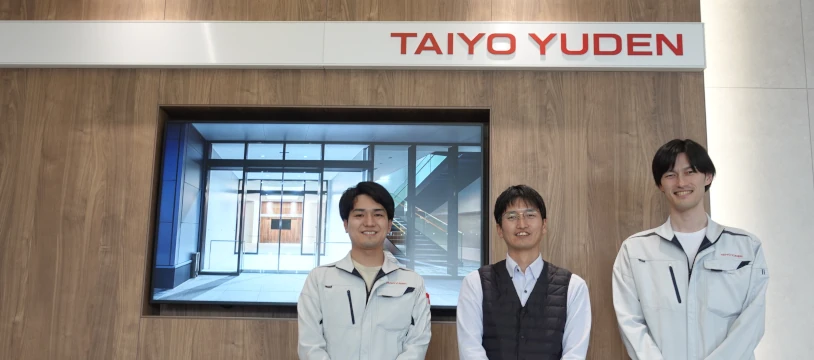
Engineers Interviewed
A. H.
Assistant Manager, Application Sales Planning Department, Marketing Division, Sales Headquarters
After joining TAIYO YUDEN in 2010, A. H. gained experience ranging from product design to mass production launch in the department responsible for the development of component-embedded boards. He then moved to the New Business Planning and Development Department, and currently serves as a Field Application Engineer (FAE), involved in marketing, market expansion, and technical support.
Y. M.
Product Development Department, Multilayer Capacitor Division, 1st Business Headquarters
After joining TAIYO YUDEN in 2016, Y. M. has been involved in the development and mass production of 1005 size embeddable MLCCs in the Product Development Department.

T. K.
Product Development Department, Multilayer Capacitor Division, 1st Business Headquarters
After joining TAIYO YUDEN in 2019, T. K. worked at its subsidiary, NIIGATA TAIYO YUDEN CO., LTD., on secondment for two years, and was involved in the mass production launch of embeddable MLCCs, among other work. He is currently in charge of developing 1608 size MLCCs.
-
Note:Department names and other organizational affiliations are those of the interviewees at the time of the interview in February 2026.
AI Servers That Handle Large Volumes of Data and the Electronic Components They Require
A. H.
The electronic equipment we use every day handles a rapidly growing volume of data, and this volume is expected to continue increasing exponentially.
Today’s mainstream AI consists of two processes: training and inference. The training process, which uses deep learning, requires substantial computing power to process vast amounts of data in parallel. The inference process, meanwhile, uses learned data to generate outputs from input data, and its applications are expected to grow. As a result, demand for AI servers that can efficiently process such large volumes of data is increasing.
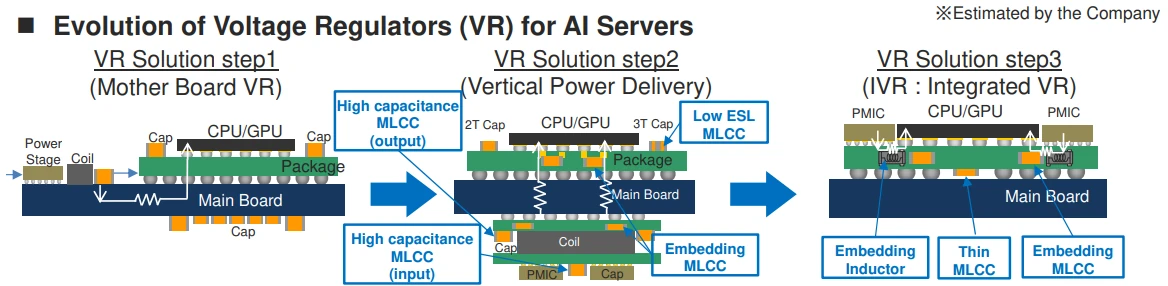
As AI servers require high-performance power supply circuits capable of handling high current, improving power supply efficiency while enhancing performance is crucial. This has led to changes in power supply methods, requiring high-density mounting of electronic components within a limited space.
Reasons for Developing Embeddable MLCCs
Y. M.
In response, we commercialized an embeddable MLCC with the world’s highest capacitance*1.
Conventional AI servers had power supply circuits arranged in parallel. However, this led to greater power loss in the wiring due to the increasing performance of semiconductors. By routing power supply circuits on the back of or inside the board, their distance from the semiconductor can be shortened, which helps facilitate current flow and reduce power loss. Embedding these circuits in the board also makes room for other components to be mounted. These factors have increased the need for embeddable electronic components, such as MLCCs.
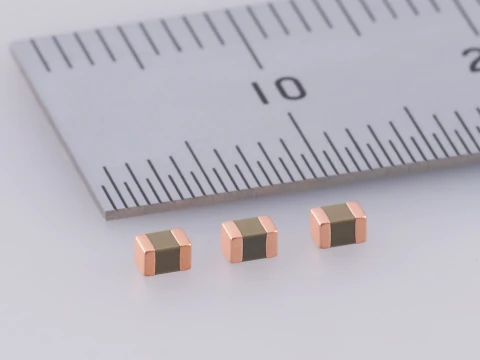
Our company commercialized two types of embeddable MLCCs for AI servers in 2025(1005 size 22 μF and 2012 size 100 μF), and is currently expanding the product lineup.
T. K.
As the internal wiring of multilayer substrates such as those used in AI servers is made of copper, embedded electronic components need to be copper-plated to facilitate bonding to the substrate. Our embeddable MLCCs feature thin, flat, plating and external electrodes. Their flat surfaces make bonding to the substrate easier when the MLCCs are embedded, helping improve reliability.
A. H.
Boards using embedded components are one of our future options that may serve as one way to address various technical issues. Meanwhile, with AI servers processing vast amounts of data, the need for embeddable MLCCs is expected to grow even further, as they enable large amounts of electricity to flow efficiently through vertical power supply while minimizing power loss and freeing up mounting space for other components.
The AI server market is rapidly expanding, with a fierce technological race underway among semiconductor manufacturers and AI platform providers. Therefore, we will continue to keep a close eye on technological changes and develop electronic components tailored to market demands.