TAIYO YUDEN Group is committed to creating a workplace where employees can fully utilize their abilities, enhancing the performance and productivity of both individuals and the organization by focusing on health, and ultimately increasing corporate value.
TAIYO YUDEN Group: Health-Oriented Management Declaration
As one of the principles comprising our Management Philosophy, we uphold "Employee Well-being", to promote the physical and mental health of employees as the management issue with the purpose of letting every employee be able to work with vigor, satisfaction and fully demonstrate their unique characteristics and abilities in their respective workplaces. To reach this goal, we will establish an organizational system to support employees and raise their awareness toward health promotion, thereby helping them and their families to lead fulfilling lives.
Katsuya Sase
Representative Director,
President and Chief Executive Officer
Organization for promoting Health-Oriented Management
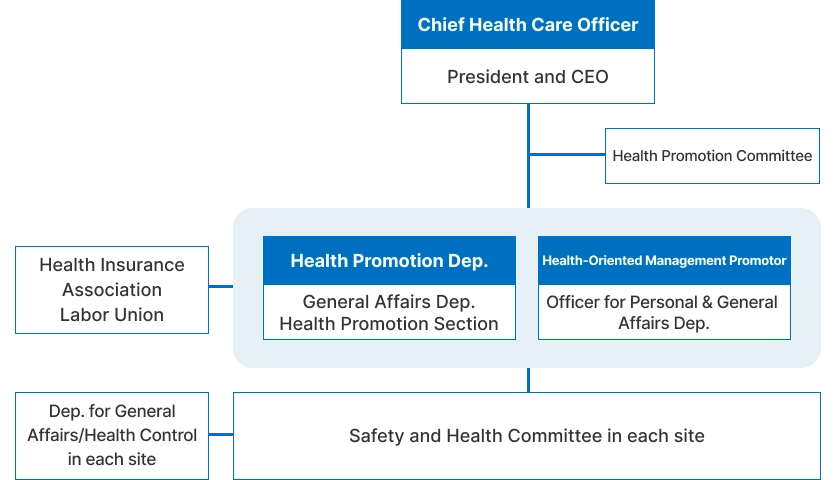
Under the leadership of the Representative Director, President and CEO, who serves as the Chief Health Officer, the executive in charge for Health Management Promotion and the Health Promotion Department, take the lead in formulating health promotion policies and priority initiatives in consultation with the Health Insurance Association, the General Affairs Department, the labor union and relevant parties.
These are reviewed at the Health Promotion Committee held twice a year, reported to the Board of Directors via the Sustainability Committee, and shared internally, including with domestic group companies. Each site collaborates with its respective Safety and Health Committee to promote initiatives that put these policies into practice, taking into account the specific characteristics of each site.
Health Promotion as the Foundation of HR Well-being
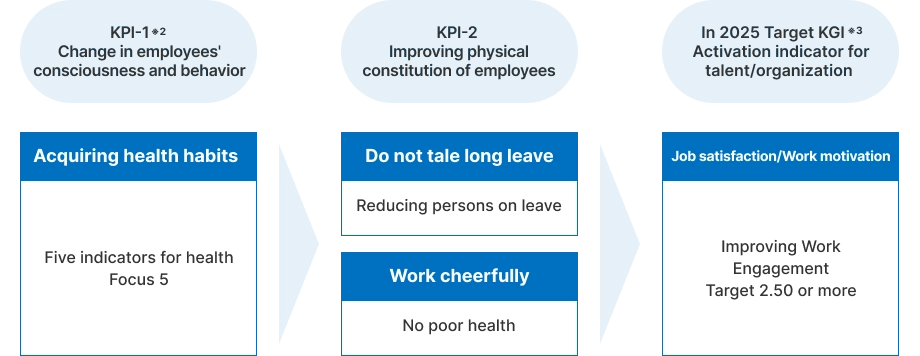
Our company has identified "Health management and workplace innovation in a safety-first workplace". We believe that enabling each employee to perform at their full potential—both physically and mentally—is the foundation of effective human capital management.
Through strategic health investments (Focus, Base, and Pillar), we drive positive changes in employee behavior and mindset. By doing so, we aim to enhance HR well-being and maximize individual potential, ultimately leading to improved productivity and enhance corporate value.
-
*HR Well-being = Human Resources Well-being
A state in which the growth of employees—the source of corporate value—and organizational growth mutually reinforce one another -
*Focus = Improvement in Quality of Life
-
*Base = Prevention of Severe Illness
-
*Pillar = Organizational Measures
Indicators for Health Promotion (TAIYO YUDEN)
Under our new mid-term management plan, which began in fiscal year 2026, we will continue to implement initiatives aimed at achieving "Focus 5", the five key indicators for promoting health.
By comparing the number of Focus 5 indicators achieved by each employee with the average scores for each category to date, we aim to further improve the health of each employee.
-
*The "FY2026 results" will be published in FY2027
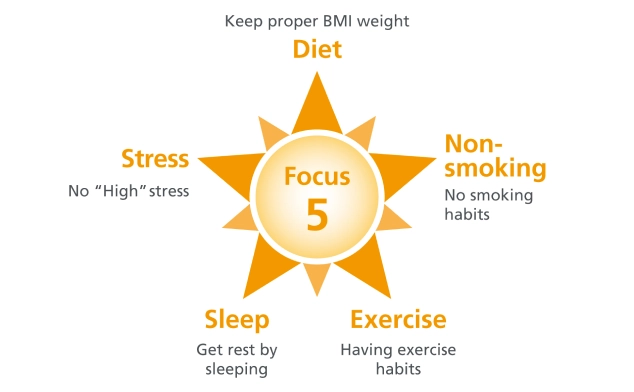
| Focus 5 | Definition | Target |
|---|---|---|
| Diet | Maintain a healthy weight |
Average number of points earned per employee 3.5 points |
| Non-smoking | No smoking habits | |
| Exercise | Having Exercise habits | |
| Sleep | Get rest by sleeping | |
| Stress | No "High" stress |
Focus 5 and Health Date (FY2025)
The correlation between the Focus 5 indicators and data on health showed that the higher the number of applicable indicators, the less abnormalities during health examination and the less ill health during stress checks.
Number of applicable Health Examination Result and Focus 5
 normality
  abnormality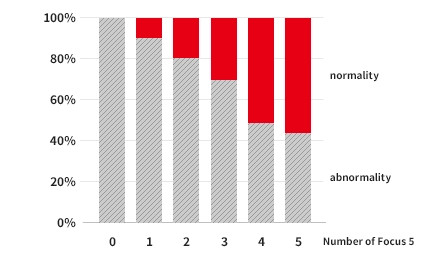
Number of applicable Physical examination results from stress checks and Focus 5
 usual
usual 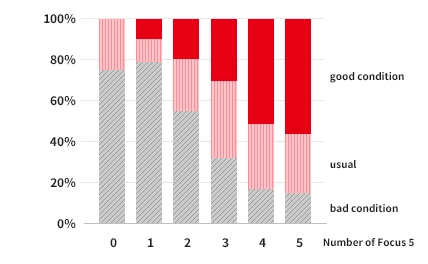
Implemented measures (FY2025)
| Indicator | Main measures | Implementation status, etc. |
|---|---|---|
| Meals |
1) Mechanism for continuous cafeteria reform 2) Implementation of dietary habit improvement events |
2) Results of Dietary Habit Improvement Events
|
| Non-smoking |
1) Strict smoking ban on premises at all times 2) Implementation of Quit Smoking Support |
2) Results of Quit Smoking Support |
| Exercise |
1) Health Promotion Seminar 2) Motor Function Assessment (Lower Limb Muscle Strength and Balance Assessment) 3) Walking Promotion Campaign |
1) Results of Health Promotion Seminar
2) Results of Motor Function Assessment (Lower Limb Muscle Strength and Balance Assessment)
3) Results of Walking Promotion Campaign
|
| Sleep |
1) Sleep Seminar Hosting 2) Implementation of Sleep Improvement Projects |
1) Results of Sleep Seminars
2) Results of Sleep Improvement Projects
|
| Stress |
1) Implementation of Feedback to Each Department and High-Risk Departments 2) Implementation of Stress Checks for Employees Assigned Overseas 3) Self-Care Seminar Hosting |
1) Feedback Status to Each Department and High-Risk Departments 2) Follow-up Measures for Stress Checks on Employees Assigned Overseas 3) Results of Self-Care Seminars
|
| Others |
1) Implementation of Measures for Women's Health Issues 2) Implementation of Measures for Alcohol consumption and Liver Function 3) Implementation of Measures for Eye Strain 4) Implementation of Measures for Hay Fever 5) Track Record of Infectious Disease Prevention Measures |
1) Results of Measures for Women's Health Issues
2) Results of Measures for Alcohol Consumption and Liver Function
3) Results of Measures for Eye Strain
4) Results of Measures for Hay Fever
5) Results of Infectious Disease Prevention Measures
|
Health-Oriented Management
| Item | FY2023 | FY2024 | FY2025 | |
|---|---|---|---|---|
| Work Engagement*1 | 2.30 | 2.28 | 2.28 | |
| Higher is preferable | Regular Health Check Rate | 100.0% | 100.0% | 100.0% |
| Varied special health check Rate | 100.0% | 100.0% | 100.0% | |
| High-risk population management (Hypertension treatment rate) |
- | 85.7% | 82.7% | |
| Health guidance for high-risk individuals (Follow-up examination rate) |
- | 60.0% | 51.9% | |
| BMI suitable (18.5 or more and less than 25) Person Ratio | 63.1% | 64.4% | 64.3% | |
| Nonsmoking Rate | 82.9% | 83.4% | 83.6% | |
| Ratio for employees with Exercise habits | 27.9% | 28.2% | 30.7% | |
| Ratio for employees able to take enough sleep | 60.5% | 60.4% | 60.9% | |
| Ratio for employees able to have motivation for improving life habits*2 | 79.2% | 77.2% | 79.9% | |
| Ratio for employees improving life habits*2 | 32.5% | 33.6% | 37.7% | |
| Ratio for taking Stress Check | 90.1% | 91.4% | 93.6% | |
| POS (Perceived Organizational Support)*3 | - | 2.83 | 2.81 | |
| Lower is preferable | High-stress person ratio by Stress Check | 15.5% | 15.8% | 14.8% |
| Ratio for employee's conscious of bad physical condition | 32.8% | 33.5% | 33.3% | |
| Presenteeism*4 | - | 23.3% | 23.6% | |
| Ratio for absenteeism (Absence due to personal injury/illness)*5 | 0.9% | 1.3% | 0.4% | |
-
*1Cited from Brief Survey Results of New Occupational Stress
-
*2Cited from the results of the answer of Q21 in Specific Health Examination Questionnaire
-
*3Calculated based on responses to the following question from an Employee Engagement Survey (response rate: 90%):
"My company supports employees in working energetically and maintaining healthy lives." (4-point scale) -
*4The Presenteeism is calculated based on SPQ (Single-Item Presenteeism Question) using the responses obtained through stress checks. Calculation formula: 100 minus the average of the responses.
-
*5Non-occupational illness and injury leave rate (applicable to all employees).
Health Promotion Initiatives
Measures Against Lifestyle-related Diseases
~Collabo-health with Health Insurance Association~
Rising risk of lifestyle-related disease and health care costs is the major challenge that cannot be avoided. Our Health Insurance Association has lowered the target age for Specific Health Check and Specific Health Guidance from the statutory age of 40 or older to 35 or older in order to encourage people to take a greater interest in their own health before the age of 40 and to prevent lifestyle-related diseases at an early stage.
For implementing Specific Insurance Guidance, nursing-job person in Health Control Room of our company is closely involved. Also, as a whole company, by cooperating with interview implementation we are making efforts to keep environmental improvement where the targeted employees are able to participate inside the company. Having efforts as background, as for Specific Insurance Guidance, implementation ratio of our company is greatly exceeding 55.0% required by the country.
TAIYO YUDEN Health Insurance Activity (FY2024)
Target: TAIYO YUDEN employees aged 40 and over in Japan
| 1. Implementation rate of specific health checkups | 99.1% |
|---|---|
| 2. Implementation rate of specific health guidance | 67.3% |
| 3. Percentage of people eligible for specific health guidance | 19.2% |
- Data source
-
-
1,2.Health Scoring Report for FY2025 (Results for FY2024) Taiyo Yuden Co., Ltd.
(Ministry of Health, Labor and Welfare. Nippon Kenko Kaigi. Ministry of Economy, Trade and Industry) -
1,2,3.Health Analysis Report 2024 Taiyo Yuden Co., Ltd.
(Taiyo Yuden Health Insurance)
-
Measures Against Mental Health
~Follow-up After Implementing Stress Check
Our company is regarding the employees applied to "High Stress Person" and also not to hope to take interview guidance by doctor as "High Risk Person" to have them supported. For High Risk Person as target person for normal insurance guidance, nursing-job person in Health Control Room will make a contact. In the case of hoping to have insurance guidance, nursing-job person will make interview based on the situation and give guidance for counseling or a series of interview on a regular (irregular) basis. For High Risk Person making efforts to confirm work-site environment and current physical condition.
Smoking Countermeasures
~Promotion by Collaboration with Health Insurance Association~
According to strengthening laws for passive smoking and Health-Oriented Management Declaration of our company, we are promoting smoking countermeasures in cooperation with Health Insurance Association from 2019. Arranging environment maintenance team for smoking site, public awareness team for making employees informed or have awareness, and quit-smoking team for conducting follow-up for the persons hoping to quit smoking, and setting the first goal as "No smoking in the site all day", we have been promoting activities with domestic group companies.
We had made step-by-step promotion: Prohibiting cigarette sales from vending machine, enlightenment events in honor of World No-Tobacco Day, installing banners and displaying no-smoking poster, holding no-smoking seminar, distributing leaflets in the place of Regular Health Check, lending books related to no smoking, no-smoking support with incentive, and reached the goal of "No smoking in the site all day" from April, 2021 as planned.
At present, for Enforcement and continuous maintenance of rules, we are conducting regular site patrol and making result reporting to Safety and Health Committee and quit-smoking support. The smoking rate in FY2025 was 16.4%, while it was 23.4% in fiscal 2019.
Support for Health-Oriented Management Initiatives
We are committed to working with our supply chain partners to promote the health and well-being of all workers. Upon request, we provide support by proposing health-oriented management initiatives and sharing relevant information.
Acquisition of Certification (TAIYO YUDEN)
White 500 for Outstanding Health and Productivity Management
We have been acknowledged for 6 consecutive years since 2021 by Japan's Ministry of Economy, Trade and Industry in its Health and Productivity Management Organization Recognition Program for our strenuous efforts toward overcoming regional health-related challenges and promoting health-conscious activities led by the Nippon Kenko Kaigi.
Excellent Corporation for the Promotion of Food Education
This program was established in 2025 to recognize companies that provide healthy meals for their employees and actively implement and assess initiatives aimed at improving dietary habits. We are honored to have received certification in its inaugural year.
Sports Yell Company
We were certified as a Sports Yell Company for 6 consecutive years since 2021 by the Japan Sports Agency in recognition of our wide-ranging activities for encouraging employees to engage in exercise and sports.

Gunma Prefecture's Partner Company for Cancer Prevention and Control
In 2021, we were certified by the Gunma prefectural government for our efforts on cancer prevention and control, particularly for raising awareness in the workplace of the importance of undergoing cancer screening tests and incentivizing employees to do so, as well as for creating an environment to enable employees with cancer to continue working while receiving treatment.