
We promote efficient environmental management by introducing environmental accounting to clarify the expenses incurred by our sites in Japan for their environmental protection activities.
Environment Maintenance Costs
| Type of cost | Expenses (million yen) |
Investment (million yen) |
Main items | |
|---|---|---|---|---|
| Business unit area costs | 2,115 | 607 | ||
| Breakdown | Pollution prevention | 874 | 26 | Monitoring and measurement of atmosphere, water quality, noise, vibration, and soil; preparations for and responses to emergencies |
| Conservation of global environment | 121 | 189 | Ozone depleting substance emission reduction, water quality improvement, exhaust gas purification, resource conservation | |
| Cost for global warming prevention | 517 | 384 | Greenhouse gas emission reduction, energy conservation | |
| Resource recycling costs | 603 | 8 | Waste management, and outsourcing of waste treatment; reduction of waste; recycling | |
| Upstream / downstream business activities | 10 | ー | Activities to improve the environmental impact of products, green procurement | |
| Management activity costs | 467 | ー | Building and operating an EMS; surveillance audits; environmental training; costs for operating secretariat; department operations costs | |
| R&D | 181 | ー | R&D costs to improve the environmental impact of product processes etc. | |
| Social activities | 18 | ー | Donations to environmental groups; participation in communities' global environmental preservation events | |
| Response to environmental damage | 82 | ー | ||
| Total | 2,873 | 607 | ||
Environment Maintenance Effectiveness
We calculate the economic effects only for those activities clearly improving our environmental impact.
| Type of effectiveness | Economic effect (million yen) |
Effects on amounts* | Main items |
|---|---|---|---|
| Energy saving | 1,177 | 17,404kL | Improvement in productivity; improvement in energy management method |
| Conservation of resources | 66 | 25,627t | Reduction of the amount of materials and resources used |
| Reduction in waste, and recycling | 4,181 | 7,307t | Improvement in recycling rate |
| Total | 5,424 |
-
*"Effects on amounts" indicate the calculated difference with the case where no activities are conducted to improve our environmental impact.
-
*No penalties related to the environment have been paid.
Trends in Environmental Accounting
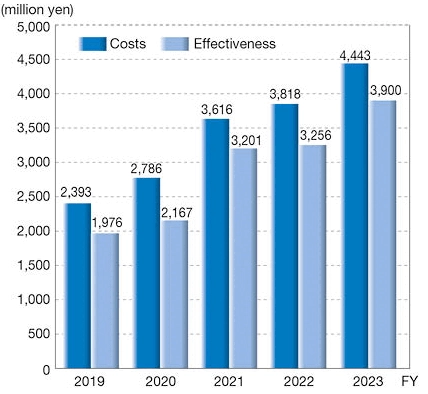
Environmental Accounting Standards
-
1.The sum total of the costs for complying with environment-related laws and regulations, the costs incurred purely for the purpose of improving our environmental impact, and the EMS operation costs are calculated. However, in cases where environmental preservation costs partially overlap the costs for other purposes, the latter shall be deducted and the balance shall be applied.
-
2.Depreciation costs shall be the current fiscal year's depreciation expenses at the environmental conservation facilities.
-
3.If a clear-cut distinction cannot be made between the environmental cost and that for other purposes, if 50% or more of the content is environment-related, the full amount can be counted as the environmental preservation cost.
-
4.The cost-effectiveness by saving energy is yielded from the reduction of either the rated dissipation or the operating time or both.
-
5.The cost-effectiveness by reducing and recycling waste is calculated as follows:
Lowered costs through reducing waste and recycling =
[Unit cost of waste treatment in the prior fiscal year (JP¥/ton) – Unit cost of waste treatment in this fiscal year (JP¥/ton)] × Amount of waste generated (tons)