
Developing Environmentally Friendly Products
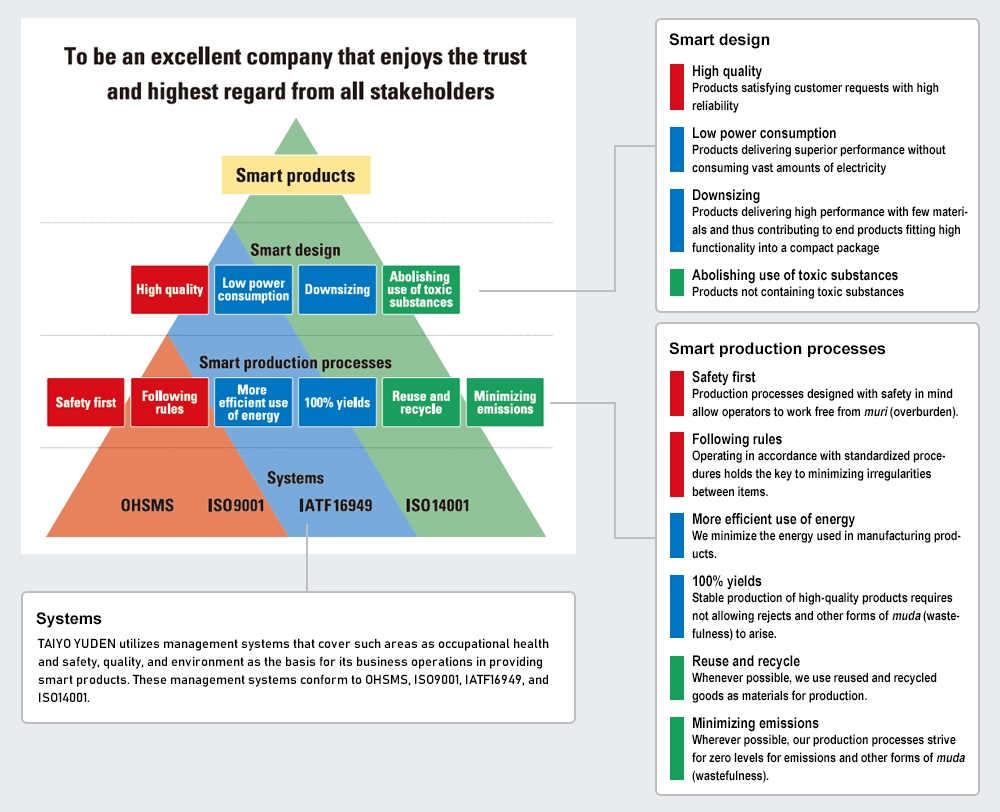
The TAIYO YUDEN aggressively promotes the development of Smart Products which can reduce environmental impact by eliminating the three M's – muda (wastefulness), mura (unevenness), and muri (overburden).
Smart Product Development System
The Smart Products that we have in mind reflect environmental
considerations not just when they are used, but at all stages from design through
production, sales, and incorporation into the final product right up to final disposal. This
means eliminating what in Japanese are called the three M's - muda (wastefulness), mura
(unevenness), and muri (overburden) - over the entire life cycle of products to give them
value for the customer, the local community, and our employees.
The first step is using
management systems for occupational health and safety, quality, environment and other
aspects as development and promotional tools to create Smart Processes that eliminate the
three M's; the second, taking usage and final disposal into due consideration, reducing the
environmental impact to create Smart Design. These key concepts of Smart Processes and Smart
Design lie behind TAIYO YUDEN Group's approach to developing Smart Products.
Efforts in Product Assessment
The magnitude of a product's impact on the environment is mostly decided
at the product planning and design stages. TAIYO YUDEN Group's Product Assessment Rules call
for a product assessment evaluating, at all steps from product development and design right
up until disposal, such issues as occupational health and safety considerations and the
effects that the product will have on the environment.
There are three evaluations from
planning and development through to mass production in the product assessment. The first,
during planning and development, is an evaluation based on investigation results of the
materials used, analysis results of the past, and other research. The second, during test
planning, is an evaluation of process design and development. The third is an evaluation
performed at the mass production trial stage.
Measures against Substances that Place Environmental Burden
In the Taiyo Yuden Group, all the products shipped in Jun. 2014 and later conform to RoHS Directive 2011/65/EU + (EU) 2015/863. Product Information on the TAIYO YUDEN website specifies whether a product complies with the RoHS/RoHS2 Directive. We are also in compliance with the REACH Directive in accordance with the law. Going forward, we will also disclose SVHC (chemical substances designated as "of very high concern" in Europe) and file and disclose data about them.
Promoting Green Procurement
To realize the overriding goal of our environmental preservation activities—supplying products with less environmental impact—we have established "Green Purchase Standard" seeking customer understanding and, at the same time, giving priority to procuring materials and parts with lower environmental impacts.
Green Purchase Standard Overview
To provide products with low environmental impact, it is essential to choose parts, materials, and subsidiary materials that comprise the product based on their low environmental effects before and during the course of manufacturing. A proactive stance toward environmental conservation on the part of suppliers is also an important criterion for procurement.
-
1.Parts, materials and subsidiary materials must not contain designated chemicals.
-
2.The supplier must have established an environmental management system (either ISO14001 or its own) and set up an environmental preservation structure.
Applying Green Purchase Standard
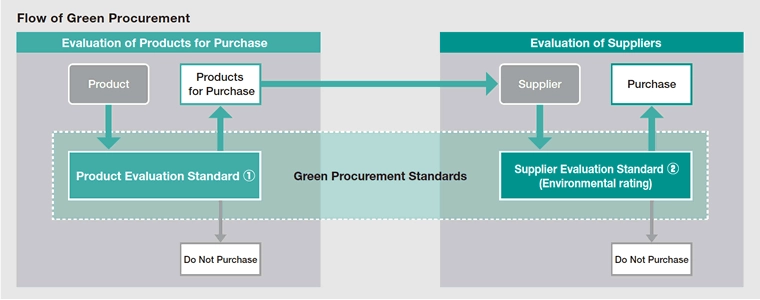
We evaluate suppliers based on our green purchase standard and the data
that they supply on their environmental preservation systems and the environmental impact of
their products.
Based on this result as well as comprehensive evaluation including price
and quality, we approve suppliers.
The new supplier approval rate in FY2025 was 100% (16
out of 16 companies).
Product Evaluation Standard (1)
We check products' chemical content by having suppliers provide RoHS compliance certificates, measurement data, ingredient tables, and other documentation at regularly scheduled intervals.
Supplier Evaluation Standard (2)
At the start of a business relationship and at regularly scheduled intervals thereafter, suppliers must conduct their own audits or submit to our on-site evaluations with regard to their environmental preservation structure.