Management System Overview, Promotion Structure
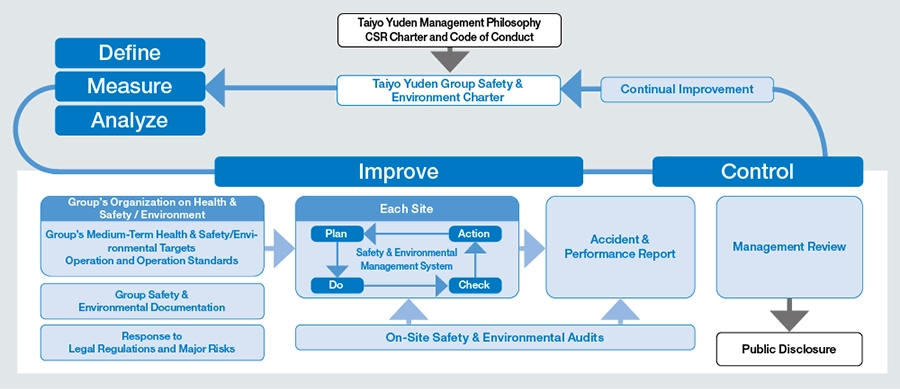
Our group-wide Safety and Environmental Management System keeps individual activities proceeding toward common goals under a common philosophy.
System Overview
This management system consists of long- and short-cycle activities.
In the
long-cycle activities, which are designed for the entire group, we are making continuous improvements
based on common goals and criteria by checking achievements based on reports about site audits and from
sites and by reviewing the management system.
For site-specific short-cycle activities, we have an ISO
14001-compliant management system and the Occupational Health and Safety Management System (OHSMS) in
place.
Promotion Structure
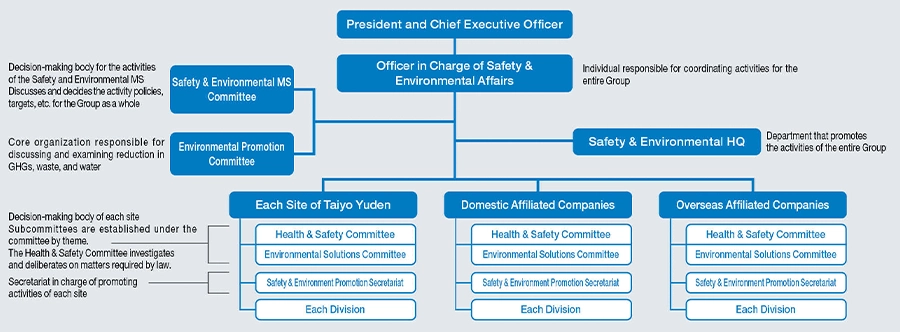
The officer in charge of safety and environmental affairs appointed by the President
and Chief Executive Officer has overall responsibility for building and managing the promotion structure
for Taiyo Yuden's Safety and Environmental Management System.
Safety and Environmental MS Committee,
the Environmental Promotion Committee debate and decide policies and issues to be addressed. Each manager
of sites then converts his/her decisions into actual plans matching the characteristics of each site, and
takes charge of publicizing, enforcing and promoting these concrete targets.
-
*MS stands for the management system.
-
*HQ stands for Headquarters.
-
*The Health and Safety Committee elects company and worker representatives.
Certification Acquisition Status
The Taiyo Yuden Group is ISO 14001 certified for its production sites and
development centers.
In addition, we address corporate responsibility in the global supply chain,
and the group undergoes the Validated Assessment Program (VAP) audits by the Responsible Business
Alliance (RBA) on a continuous basis in line with the set plan.
List of Certifications Acquired
| Location | Name of Sites | Acquired ISO14001 Certification | Certification authorities |
|---|---|---|---|
| Japan | TAIYO YUDEN CO., LTD. Takasaki Global Center,Haruna Plant, Nakanojo Plant, Tamamura Plant, Yawatabara Plant, R&D Center TAIYO YUDEN CHEMICAL TECHNOLOGY CO., LTD. FUKUSHIMA TAIYO YUDEN CO., LTD. NIIGATA TAIYO YUDEN CO., LTD. WAKAYAMA TAIYO YUDEN CO., LTD. TAIYO YUDEN Mobile Technology Co., Ltd. Kankyo Assist Co., Ltd. ELNA CO., LTD. |
22046582 (as of Oct. 1998) Collectively certified in Japan |
BV |
| South Korea | KOREA KYONG NAM TAIYO YUDEN CO., LTD. | KR004983 (as of Mar. 2002) | BV |
| China | TAIYO YUDEN (CHANGZHOU) CO., LTD. | CN055260 (as of Jun. 2025) | BV |
| TAIYO YUDEN (GUANGDONG) CO., LTD. | CN057234 (as of Dec. 2001) | BV | |
| Philippines | TAIYO YUDEN (PHILIPPINES), INC. | PH13/0920 (as of Nov. 2001) | SGS |
| Malaysia | TAIYO YUDEN (SARAWAK) SDN. BHD. | EMS00226 (as of Oct. 2002) | SIRIM |
| ELNA (MALAYSIA) SDN. BHD. | 17318-E (as of Dec. 2003) | Kiwa | |
| Thailand | ELNA (THAILAND) CO., LTD. | 04 104 990506 (as of Mar. 2004) | TUV |
RBA-VAP Audit
TAIYO YUDEN Group has implemented activities to comply with the RBA (Responsible Business Alliance) Code of Conduct, which is a code of conduct related to social responsibility. We regularly have the RBA-VAP audit as third-party evaluation to enhance level of labor, ethics, health and safety, and environment continually. Subjects of the audit are 16 manufacturing sites.
| TAIYO YUDEN CO., LTD. (Japan) | Haruna Plant / Nakanojo Plant / Tamamura Plant / Yawatabara Plant |
|---|---|
| Consolidated Subsidiary (Japan) | TAIYO YUDEN CHEMICAL TECHNOLOGY CO., LTD. / FUKUSHIMA TAIYO YUDEN CO., LTD. / NIIGATA TAIYO YUDEN CO., LTD. / WAKAYAMA TAIYO YUDEN CO., LTD. / TAIYO YUDEN Mobile Technology Co., Ltd. / ELNA CO., LTD. (Shirakawa Factory/Aomori Factory) |
| Consolidated Subsidiary (Other Countries) | KOREA KYONG NAM TAIYO YUDEN CO., LTD. TAIYO YUDEN (CHANGZHOU) CO., LTD. TAIYO YUDEN (GUANGDONG) CO., LTD. TAIYO YUDEN (PHILIPPINES), INC. TAIYO YUDEN (SARAWAK) SDN. BHD. |
Audit
Triple audits evaluate each site's compliance, accident risk management, and the environmental impact situation aimed at producing continuous improvement.
External Audits
- ISO14001 certification audits by certification authorities
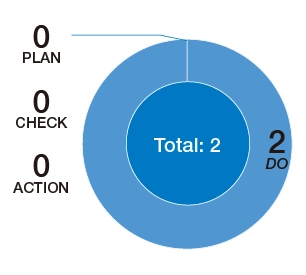
- Sites with ISO14001 certification underwent the audits required to update or maintain such certification. These audits uncovered 8 nonconformities. The root causes were analyzed and corrective action was promptly taken in response to each issue. The nonconformities were minor issues related to the management systems and would not directly cause environmental pollution or occupational accidents.
Number of Nonconformity Instances Found with External Audits
Nonconformity Examples
- Details of nonconformities
- The procedures for reviewing the emergency response drills that had been conducted were insufficient.
- Corrective/remedial actions taken
- The relevant rules were revised to ensure that emergency response procedures are reliably reviewed, and training was implemented to the personnel concerned.
- Details of nonconformities
- Some waste containers had deficiencies in their identification labels.
- Corrective/remedial actions taken
- The rules on identification labels for waste containers were revised, and training was implemented to the personnel concerned.
The RBA-VAP audits for FY2025 have been completed at 5 domestic sites and 3 overseas sites.
Internal Site Audits
- Audits of site safety and environmental activities at regularly
scheduled intervals allow us to compare sites.
(Domestic sites: Once every two years, Overseas sites: Once every three years) - In FY2025, site audits were conducted to verify compliance with
customer requirements and the safety, health, and environmental requirements of the RBA Code of
Conduct, as well as the implementation status and maintenance of safety and environmental risk
countermeasures.
During the audits, auditors reviewed documents and conducted on-site inspections regarding such matters as the controls for potential hazards based on customer and RBA requirements, management of required protective equipment, emergency preparedness, management of chemical substances, waste, air quality, and water quality, and education and training.
The audits revealed deficiencies in the areas of protective equipment management, fire extinguisher management, and labeling management.
We aim to improve the level of health, safety, and environmental protection activities for the whole group by globally incorporating societal requirements in a timely manner and sharing the results after benchmarking products from all sites.
Issue Examples
-
There were some deficiencies in the management of protective equipment inspection records.
-
Materials placed around some fire extinguishers obstructed access to them in the event of use.
-
Some deficiencies were found in the information shown on the GHS* labels on waste liquid containers.
-
*GHS: The Globally Harmonized System of Classification and Labelling of Chemicals
Internal Audits
- Audits targeting site departments on observance of safety and
environment laws, target achievement, and performance.
(Once or twice every year) - All sites conducted internal audits of their departments in
accordance with their management systems. Priority areas were determined for each site, and 20
nonconformities were uncovered as a result of conducting internal audits (at sites in Japan).
Corrective action was completed in all cases without delay, and after a follow-up check, it was reported to the top management that the management system has been effective in complying with the Taiyo Yuden Group's policies and goals.
Other Audits
On-site inspection of waste disposal contractors (Sites in Japan)
During FY2025, we inspected and audited 22 companies (5 collection, delivery, and intermediate processing companies; and 17 intermediate processing companies). The results showed that all inspected operators are processing and disposing of waste appropriately. The operators have also been classified into three ranks from the results of these inspections, with the frequency of future inspections varying depending on the rank of the operator.
Training
We provide a variety of training programs covering both general and specialized knowledge to promote employees' awareness of preventing occupational injury and illness, as well as active participation in environmental conservation.
Training Structure
| Name | Category | Purpose | Main Subjects | |
|---|---|---|---|---|
| General Training | Training for new recruits | Awareness | Raising new recruits' awareness of occupational health and safety and environmental preservation, and ensuring they understand environmental problems pertinent to companies | General theory of Safety, Health, and Environment/ Status of Safety, Health, and Environment at the Taiyo Yuden Group |
| General training | Deepening all employees' understanding of the Taiyo Yuden Group Safety, Health, and Environment Charter and Course of Action, and teaching them the skills to act accordingly | Management system (including the Safety, Health, and Environment Charter) / Mental health | ||
| Workplace training | Understanding potential hazards and environmental impact with
regard to divisional health and safety/environmental activities and work |
Division activities / Matters for compliance in work | ||
| Health & Safety Training | Training for managers, instructors and supervisors | Abilities | Deepening understanding of the role of the duty for employee safety required by legal regulations and teaching foremen skills to instruct their subordinates regarding health and safety. | Role of the General Manager of Health and Safety / Role of management / Role of foreman / Chemical substance management/Hazardous material management |
| Training for specialists | Teaching of specialized skills to operators of forklifts, cranes, and other heavy equipment, as well as managers of processes that handle organic solvents and the like, and employees involved in these tasks | Workplace restricted duties / Training for specific tasks / Prevention of static electricity accidents | ||
| Training for risk assessors | Teaching the skills to recognize risks and creating a safe and sanitary workplace | Risk assessment/Health and Safety targets / Cases of Health and Safety improvements / Causes of Health and Safety accidents and their countermeasures | ||
| Environmental Training | Training for specialists | Teaching special skills to managers and relevant employees involved with equipment and facilities for which a legal notification is required | Management to prevent deterioration of water quality / Management to prevent air pollution/Waste management | |
| Specialized training | Training skills to integrate business activities with environmental activities in order to balance an improvement in our environmental impact with improved resource productivity | Chemical substances and their environmental impact /Environmental targets/Cases of environmental improvements/Causes of environmental accidents and their countermeasures | ||
Training Examples
General Training
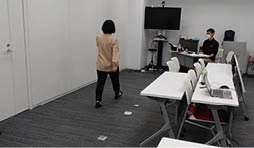
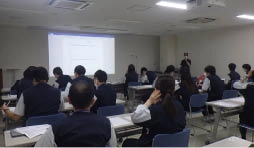
- Holding events related to health and safety
- We hold various events related to health and safety at all sites and these events provide opportunities for employees to raise their awareness and develop their abilities. Examples include health classes on stretching techniques to help reduce fatigue and driving aptitude tests using a driving simulator.
Occupational Health and Safety Training
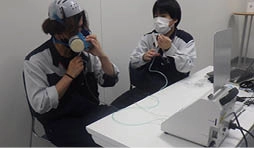
- Training on how to wear the respiratory protective equipment
- Training was conducted on the proper way to wear masks, including mask positioning and strap tightness, while using measuring equipment to assess mask-to-face fit in real time.
- Aerial work safety measures training
- Practical instruction on the proper way to wear a full-body harness safety belt and how to use ropes and equipment in order to prevent falls when working at heights was provided by an external instructor.
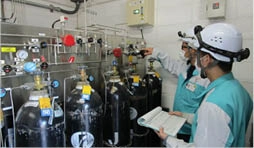
Environmental Training
- Training for wastewater treatment facility managers
- Training was conducted for wastewater treatment facility managers on such topics as trends in water quality laws and regulations, the latest water treatment technologies, and the fundamentals of industrial wastewater treatment, including on-site practical training.
- GHG Emissions Reduction Training
- To continuously promote initiatives to reduce GHG emissions, training was conducted on the relationship between business activities and GHG emissions, as well as specific measures for reducing emissions.