
CEO Message
Achieving sustainable growth as an electronic components manufacturer supporting a connected society
Katsuya Sase
Representative Director, President and CEO
Realization of Sustainable Well-Being to Contribute to Social Happiness
TAIYO YUDEN has been striving to fulfill the core priorities adopted as its management philosophy. These include a focus on employee well-being, the betterment of local communities, and the responsibility to provide returns to shareholders. Adopted by our founder, this philosophy lives on today as the underlying spirit of our company.
When formulating the Medium-Term Management Plan 2025, which we began in FY2021, we systematized the mission and vision based on these priorities. As a result, we clarified the direction in which the Company should be moving and the attitude our employees should adopt in their work. However, I came to think that we also needed to articulate our raison d'être, specifically, what value are we bringing to society by our company’s growth.
Accordingly, as we launched the Medium-Term Management Plan 2030, we have added the term sustainable well-being into our philosophical framework. This expresses our determination to make a contribution through the Company’s business activities, thereby enabling people and society to remain in a state of sustained happiness. With a view toward FY2030, TAIYO YUDEN formulated a 10-year plan comprising two stages: Medium-Term Management Plan 2025 (Step 1) and Medium-Term Management Plan 2030 (Step 2). As we prepare for the challenges in that latter phase, we have once again articulated the philosophy that has long and consistently underpinned our business activities. Guided by this more clearly defined framework of corporate principles, we will continue to focus on developing innovative technologies that will lead us to tackle social issues, while aiming to achieve both contributions to our stakeholders and sustainable growth.
Looking Back at Medium-Term Management Plan 2025:Strengthening Adaptability to Change Based on Lessons Learned from Unachieved Targets
Looking back at the Medium-Term Management Plan 2025, we unfortunately fell short of our economic value targets. Although performance proceeded at a pace exceeding expectations for about a year and a half following the launch, the market environment subsequently deteriorated as a reaction to that, resulting in a widening gap between the plan and the actual results. Not simply a matter of accepting the situation as unavoidable due to poor conditions, we estimate that external factors accounted for 60% and internal factors for 40%.
The external factors included a succession of changes that exceeded expectations, such as the COVID-19 pandemic and the materialization of geopolitical risks. Amid changing market environment conditions, demand in each market also fluctuated greatly. For example, growth in the smartphone market fell significantly short of projections, whereas the automotive and IT infrastructure/industrial equipment markets expanded substantially. Demand for AI servers expanded rapidly, particularly in the latter half of the Medium-Term Management Plan 2025.
In the case of internal factors, our inability to adequately respond to these market changes in terms of product composition and supply capacity can be cited. Whereas we have long prioritized risk management, our response to low-frequency risk has, in retrospect, remained merely perfunctory. Having experienced the supply chain disruptions caused by the COVID-19 pandemic and international conflicts, I have become keenly aware that we faced challenges when it came to determining the extent to which we could realistically prepare for risks that, while infrequent, carry a massive impact when they do occur. The lesson learned from these experiences is the importance of building business structures that are capable of adapting to change.
Rather than attempting to fully predict societal shifts or demand fluctuation cycles, for the Medium-Term Management Plan 2030 we have placed a heavy emphasis on enhancing our ability to adapt to change. The key point lies in putting in place a system that allows for flexible operations while strengthening Q (development capability), C (profitability), and D (supply capacity) aspects. By evolving into a corporate structure capable of reliably meeting demand during periods of growth while generating consistent profits even when demand is weak, we will realize management that responds agilely to environmental changes.
Medium-Term Management Plan 2030
Growth Strategy for Medium-Term Management Plan 2030:From MLCC Manufacturer to Electronic Components Manufacturer
For the Medium-Term Management Plan 2030, we have set the targets for economic value at the same level as in the Medium-Term Management Plan 2025 (→Medium-Term Management Plan 2030 Key Performance Indicators). Judging solely by the figures, this might be perceived as a renewed attempt to achieve targets that were not previously achieved. In reality, however, these are newly established targets based on updated forecasts for each business and market. In other words, even though the figures remain the same, the underlying structure differs significantly from last time, and I believe the probability of achieving the targets is also vastly different.
Most importantly, a major difference lies in how we view our business portfolio. In the Medium-Term Management Plan 2025, we prioritized cultivating second and third pillars of business to follow multilayer ceramic capacitors (MLCCs), factoring in the growth of these areas—as well as the expansion of new businesses—in our sales targets. Ultimately, whereas the inductor business yielded solid results, the communication device segment suffered a significant decline due to stalling demand for smartphones, and the launch of new businesses also faced difficulties. In light of the fact that such overly optimistic assumptions contributed to our failure to meet targets, we have formulated the targets for the Medium-Term Management Plan 2030 from a more realistic perspective. While continuing to position MLCCs at the core of our business, we have established inductors as a solid second pillar and are forecasting steady growth driven by these two product lines.
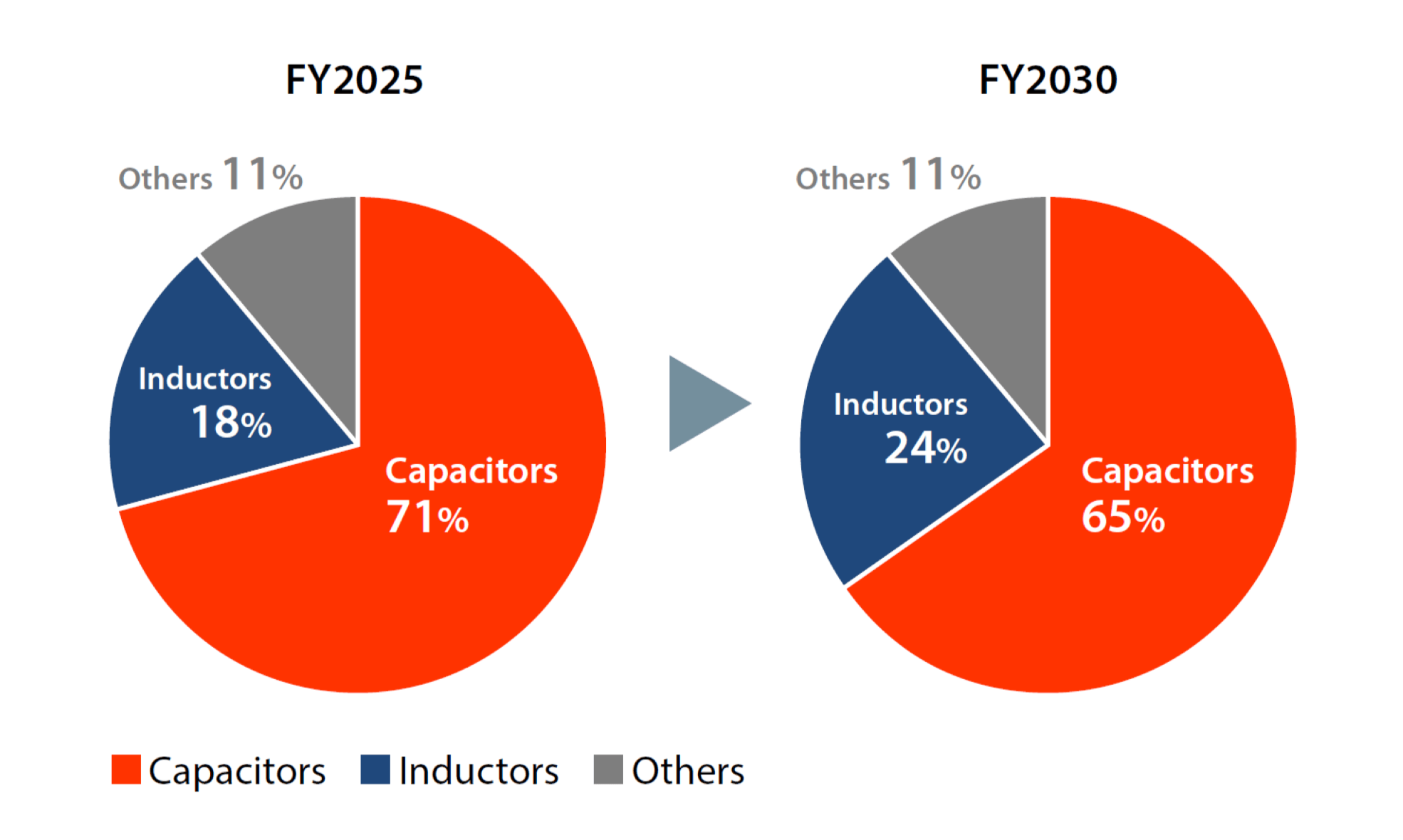
Management plans centered on both MLCCs and inductors will not only increase the probability of achieving our targets but also serve as a statement of our intent to establish ourselves as an electronic components manufacturer that offers more than just MLCCs. To achieve stable growth, it will be crucial to diversify our revenue streams, and thus we will build a balanced corporate structure by further honing the competitiveness of our MLCCs while accelerating the growth of our inductor business.
As for capital investment, we will consider accelerating the timing of investments in areas where demand is currently expanding. This, however, does not mean we will be indiscriminately venturing into areas where the outlook remains uncertain. While ensuring we do not miss out on future growth opportunities and maintaining investment discipline, I intend for us to strike a balance between supply capacity and profitability.
Responding to Demand in High-End Markets to Help Realize a Connected Society
Our vision of society for the medium to long term is that of a connected society in which everything is networked and data flows in real time. AI servers serve as the foundation for this, and their market has been expanding rapidly in recent years. Due to the improvements in AI processing capacity, issues such as rising power consumption, power loss, and heat buildup have emerged, driving burgeoning demand for the high-performance MLCCs and inductors that will assist in resolving them.
The MLCC market is structured like a broad-based pyramid. In the case of the commodity products at the base of the pyramid, representing the lower end of the market, there are many players and price competition is fierce. In contrast, the closer toward the apex you go, the greater the level of technical expertise required, thereby limiting the number of companies capable of meeting those demands. TAIYO YUDEN’s focus is on the latter, the high-end sector. We will consolidate our presence in the market by responding to highly complex customer demands, such as for small, high-capacitance products with low power consumption, by combining the various elemental technologies that are our forte.
While the performance required of inductors varies depending on the application, TAIYO YUDEN’s strengths lie in areas that support next-generation designs, such as compact, high-current, embedded-substrate products. In addition to improvements in basic performance, this area demands high precision, such as in product dimensions. I believe this plays to the Company’s strengths, as we possess not only advanced materials technologies but also exceptional manufacturing capabilities.
Since they are used in exceptionally high volumes, multivendor sourcing is standard practice for MLCCs due to procurement risk considerations. In contrast, cutting-edge inductor applications offer the potential for products with superior technological capabilities to secure a dominant market position. In that sense, I view inductors as a crucial product category for enhancing TAIYO YUDEN’s presence as an electronic components manufacturer.
Steadily capturing the current demand for AI servers, we are forecasting that sales of MLCCs for AI servers in FY2026 will increase by 150% year on year (as of August 2026). However, while viewing AI servers as a core market within the connected society, we are not limiting our focus to that area alone. Leveraging our technological capabilities, we will propose new solutions across a wide range of fields that constitute a connected society. Those fields include AI and robotics, automotive/mobility, space, energy, healthcare, and environmental/resource circulation. Based on the realization of sustainable well-being newly adopted in our mission statement, it is my belief that this will drive the Company’s sustainable growth.
Establishing a Sustainable Business Foundation:Commitment to the Environment and Human Capital
Under the Medium-Term Management Plan 2030, our policy is to grow into a company with a meaningful presence in society. We will accomplish this by viewing economic value and social value as the twin drivers of enhanced corporate value and strengthening both in a balanced manner. Based on this policy, we have been undertaking a review of our KPIs from the Medium-Term Management Plan 2025.
With regard to the environment, we have reevaluated our ongoing GHG reduction initiatives from a longer-term perspective. Whereas the Medium-Term Management Plan 2025 already included targets looking ahead to FY2030, this time we have clarified our direction toward carbon neutrality with a view to FY2050. To strengthen efforts to reduce environmental impact across the entire supply chain, we have incorporated Scope 3 in initiatives that we had previously been advancing with a focus on Scopes 1 and 2.
We also reviewed our human capital KPIs. As safety-related metrics, we have shifted our focus from simply reducing the conventional accident rate to achieving zero serious occupational accidents. While the importance of consistent, day-to-day efforts—such as disaster preparedness drills and activities to prevent near-miss incidents—remains unchanged, the focus here is on shifting away from merely tracking numbers. Instead, we are returning to the fundamental perspective of how to create workplaces where serious occupational accidents do not occur.
With regard to our employees—the source of our corporate growth—we have also established a new HR Well-being Index. This was independently established as an indicator to quantitatively ascertain the status of a variety of aspects, such as employee well-being and health, work styles, diversity, growth, job satisfaction, and organizational culture.
Although initiatives relating to the environment and human capital are not something that yields tangible results in the short term, we view them as essential to realizing our vision, mission, and underlying management philosophy, and will continue to focus our efforts on them.
To Remain an Excellent Company That Enjoys the Trust and Highest Regard from All Stakeholders
Since its founding in 1950, TAIYO YUDEN has long been supporting the foundation of a society that is safe, secure, comfortable, and convenient through technological innovation in electronic components. Since we are aiming to be a 100-year company, this fundamental stance remains unchanged. We also aim to remain a company that contributes to the sustainable well-being of people and society by encouraging the creation of environments in which each and every employee can grow with pride and curiosity, and fully demonstrate their capabilities.
FY2026 marks the first year of the Medium-Term Management Plan 2030. Under the previous Medium-Term Management Plan 2025, we steadily laid the groundwork for the future by taking measures such as securing supply capacity by means of upfront investments and shifting toward high-value-added areas. Building upon these initiatives, I would like us to continue creating new value by leveraging our core technologies—such as electronic components and solutions that help address social issues—and remain an excellent company that enjoys the trust and highest regard from all stakeholders.
As we continue to pursue further growth through dialogue with our stakeholders, I respectfully ask for your continued support of TAIYO YUDEN.