
Message from the Officer in Charge of Finance
Focusing on high-value-added areas, increasing profitability and supporting sustainable growth
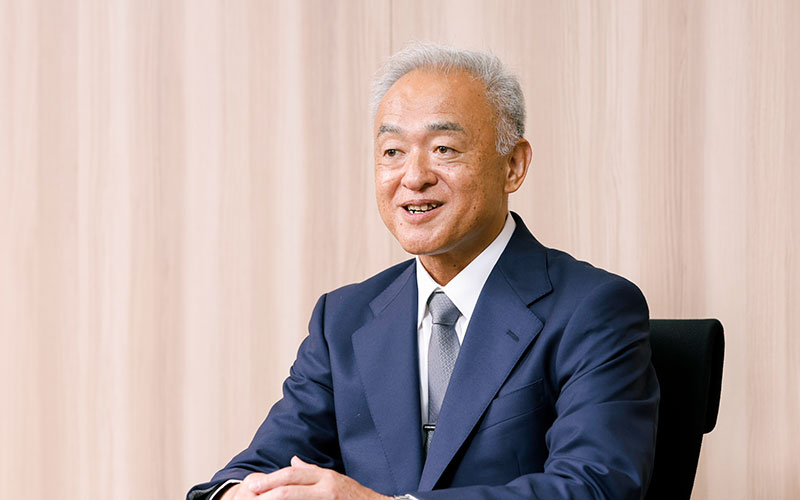
Tomomitsu Fukuda
Director and Senior Executive Operating Officer in Charge of Management Planning Headquarters
Looking Back at FY2025A Year in which We Laid the Foundation for Recovery in Profitability
In addition to increased sales of multilayer ceramic capacitors (MLCCs) for AI servers and automotive applications, inductors such as those for memory modules also contributed to improved business performance in FY2025, resulting in year-on-year revenue and profit growth.
As the final fiscal year of our five-year Medium-Term Management Plan 2025, when again looking back at FY2025 I view it as one in which we worked to optimize our earnings structure while advancing preparations for our next phase of growth.
Amid a challenging profit environment from the middle of FY2022 onward due to sluggish demand and prolonged inventory adjustments, the Company had been making upfront investments on an ongoing basis to strengthen future supply capacity. However, in part because the recovery in demand was slower than anticipated, the burden of fixed costs became particularly onerous. In light of such circumstances, we curbed investment and promoted the optimization of fixed costs during FY2025 and were able to achieve a certain level of results.
In the meantime, there were also challenges. Due to a prolonged slump in demand, in the communication devices business we implemented a second round of structural reforms while reducing the scale of the business and costs. We are currently working on restructuring the business by shifting toward high-value-added areas.
Medium-Term Management Plan 2030Accelerating Expansion into High-Value-Added Areas
Under the Medium-Term Management Plan 2030, the core of our growth scenario is to improve profitability in stages by increasing the ratio of high-value-added products. Promoting a shift in our product mix in line with changes in the composition of demand, the intention is to raise profitability over the course of several years.
In contrast, AI-related demand is currently rising at a faster pace than initially anticipated, thus presenting a prime opportunity to deliver results ahead of schedule. In this sense, I view FY2026 not only as the launch year of the Medium-Term Management Plan 2030 but also as a crucial year for establishing the framework for our next phase of growth. It is my belief that enhancing our development capabilities and establishing a system to supply high-end products in a timely manner will determine our growth potential from the next fiscal year onward.
With regard to capital investment for the duration of the Medium-Term Management Plan 2030, we had planned to implement increases in capacity of approximately 10% annually across our entire MLCC operations. However, in light of AI server demand exceeding our forecasts, I project that we will increase capacity by 10–15% in FY2027. Rather than investing heavily across the board, we are focusing on investments designed to resolve bottlenecks in high-growth areas such as products for AI servers while carefully balancing investment and returns on investment.
Under the Medium-Term Management Plan 2030, we have outlined a policy to increase to 60% the sales ratio of focus markets—such as IT infrastructure/industrial equipment and automobiles—but this does not imply an over-reliance on any specific market. My view is that if we secure an appropriate position in markets where demand growth is anticipated and which align well with our high-value-added strategy, that ratio will ultimately reach 60% as a result. I believe it is important to make investment decisions that seize growth opportunities while maintaining investment discipline.
Advancement of ROIC-Based ManagementSelection and Concentration Advanced by Clarifying Decision-Making Criteria
Starting with the Medium-Term Management Plan 2025 we adopted a return on invested capital (ROIC)-based management approach. The greatest achievement arising from that has been that the criteria for evaluating businesses have become clear. It has become easier than ever—both for senior management and for all working-level staff—to determine which business areas should receive resource allocations and where to pursue a strategy of selection and concentration. It was for the very reason that we had such a framework for decision-making in place that we were able in some respects to quickly clarify our direction with regard to measures such as the structural reform of our communication devices business and the scaling back of our circuit module business.
If we break down the elements of ROIC into profitability and efficiency, I view the ongoing improvement of profitability as a challenge. To address this challenge, we plan to enhance our development capabilities and increase sales of high-value-added products.
With regard to efficiency, the need to strike a balance with business continuity is currently being called into question, and we are required to maintain a certain level of inventory as part of our Business Continuity Plan (BCP) measures. Measures designed to maintain stable supplies in the event of an emergency—such as production base diversification and the securing of multiple logistics channels—can sometimes also have aspects that reduce efficiency in the short term. However, viewing them as a necessary initiative to continue fulfilling our supply responsibilities as a company, I believe such measures to be connected to sales, profits, and ultimately, corporate value.
Based on this understanding, to work toward an improvement in ROIC, we will also strengthen management with regard to both throughput ratio and fixed cost ratio aspects. We will visualize key metrics—such as whether high-value-added products are selling as targeted and whether fixed costs are commensurate with the scale of sales—to establish a structure that enables continuous improvement of our operating margin.
Capital Allocation PolicyPrioritizing Balance Between Three Elements: Growth Investments, Shareholder Returns, and Sound Financials
Under the Medium-Term Management Plan 2030, our approach to capital allocation is to prioritize the balancing of three elements: growth investments, shareholder returns, and sound financials.
While growth investment is essential for enhancing the Company’s corporate value, we have already established a certain level of supply capacity by means of the ongoing upfront investments made under the Medium-Term Management Plan 2025. In the years to come, we will remain more keenly aware of the importance of financial soundness and conduct management operations with a focus on investment efficiency.
Under the Medium-Term Management Plan 2030 the basic policy for capital investment is to focus investments on high-profit areas that offer the prospect for high returns, while keeping spending within the amount of depreciation. I believe that this will enable us to absorb the investment burden and lead to the stable generation of free cash flow.
With regard to our balance sheets, rather than setting specific numerical targets, we are placing priority on maintaining a balance between investment and financial soundness. We are devising ways to conduct flexible operations that respond to market changes, curtailing investment when demand is weak, while investing to gain returns when opportunities arise. By means of this approach, we aim to strike a balance so that we do not miss out on growth opportunities or undermine our financial foundation.
To Our InvestorsIn Working Toward Sustainable Growth, Shifting to a Profit-Generating Structure
When assessing our growth potential, the first point I would like investors to focus on in the coming years is the improvement of our operating margin. Of equal importance is whether that improvement is accompanied by sales growth. I would also like them to focus on whether the Company is shifting to an organization that generates sustainable earnings, as evidenced by improvements in ROIC and free cash flow as well as progress in optimizing fixed costs.
With regard to shareholder returns, our policy prioritizes dividend stability, and we have set a target of a 30% dividend payout ratio combined with a 3.5% Dividend on Equity (DOE). In the medium- to long-term, we aim for a DOE of 4.5%, but we view this as an outcome to be achieved as the result of achieving a stable ROE of 15%. The first step is to build a corporate structure capable of boosting the operating margin and reliably securing net profit. I believe that if our earnings power steadily increases, the result will be an improvement in ROE and an ability to raise the level of DOE.
The shift we are pursuing under the Medium-Term Management Plan 2030 centers on steadily restoring our earnings power while increasing the sales ratio of high-value-added products. I would appreciate it if you too could view TAIYO YUDEN from a medium- to long-term perspective as we work to look beyond mere short-term figures and shift instead to a structure that generates sustainable earnings.