

AI Server Demand Opportunities
— Our Accumulated Technologies and Know-How Supporting the Infrastructure of the Next-Generation Society
Accelerating Use of AI
At present, our society is at a major turning point. The volume of data for processing is increasing at an exponential rate due to the rapid spread of generative AI and other digital technologies. These changes are dramatically transforming the design of AI servers at the core of data centers. The high-performance semiconductors (CPUs/
Demand Forecast
Electronic Component Growth Will Exceed Growth in Production Volume
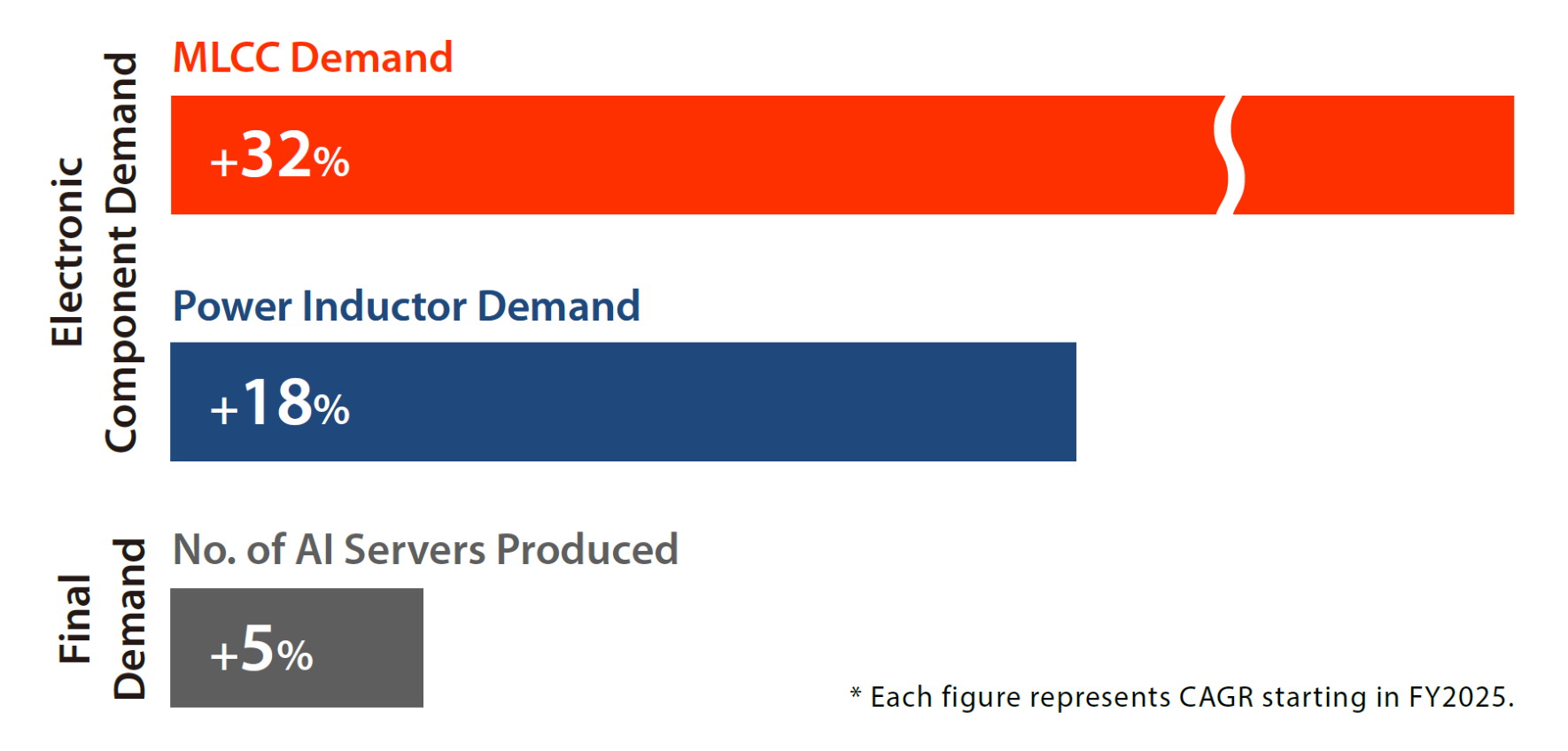
The AI server market is experiencing changes and growth that go beyond simply increasing production volume. Under the Medium-Term Management Plan 2030, we forecast that AI server production volume will grow at a compound annual growth rate (CAGR) of +5% from FY2025 to FY2030. Meanwhile, demand for MLCCs installed in AI servers is forecast to grow at a CAGR of +32%, while demand for power inductors is forecast to grow at a CAGR of +18%. We expect growth in electronic components to significantly outpace growth in end products.
We estimate that the number of MLCCs installed per AI server will more than double from FY2025 to FY2030 as performance improves, with the number of inductors also increasing significantly due to changes in power supply methods. Furthermore, in addition to the number of components installed, we must meet increasingly sophisticated technical requirements, including smaller sizes and higher capacities in line with growing design complexity. Amid the ongoing shift toward high-value-added products, the rise in component value per server is driving demand. Demand for AI servers is currently stronger than anticipated, and we expect very strong growth going forward.
| Market Trends | No. of Electronic Components per Unit (2025–2030) |
|
|---|---|---|
| MLCC | We are working to develop smaller, higher-capacity models and integrate these products into motherboards for improved performance and reduced power loss | 10,000 to 20,000 ↓ More than double |
| Inductor | Demand for AI servers has increased significantly due to changes in power supply methods | Significant changes in power supply methods and increased demand |
Technological Advantages
TAIYO YUDEN’s Prominent Presence in the High-End Sector
The reason we are able to meet the technological requirements of the AI server market and are chosen by customers is our vertical integration of advanced core technologies, including materials, multilayer, and design technologies that we have continuously refined in the high-end sector.
For example, AI servers are equipped with high-performance CPUs and GPUs that draw high currents, thus peripheral electronic components must be both higher capacity and smaller to save space and reduce power loss. With an eye toward future improvements in semiconductor performance, we focused from an early stage on the development of high-capacity MLCCs exceeding 100 μF, and in 2011, we commercialized the world’s first 220 μF MLCC and have since expanded our product lineup to 470 μF, thereby establishing high-capacity technologies. These accumulated technological advances have enabled us to respond to the current demand for AI servers.
These advanced technological capabilities give us a strong competitive advantage in cutting-edge, highly complex fields that other companies cannot easily match. Furthermore, even in fields other than AI servers, we expect business opportunities to increase as the technical barriers for electronic components continue to rise.
Under the Medium-Term Management Plan 2025, we have focused on increasing production capacity through the completion of large-scale capital investments such as the building of new factories in China and Malaysia, as we have prepared to respond to the rapidly increasing demand for AI servers. Under the Medium-Term Management Plan 2030, we will leverage our production capacity and advanced technological capabilities to develop high-value-added products and accelerate improvements in profitability.
Column
Inductor Outlook: Power Supply Design Advances and Patent Advantages
As AI server performance improves, the power supplied to CPUs and GPUs increases year by year, and power supply designs are required to be more efficient, with lower loss, and higher density implementation than ever before. To meet these demands, there is a growing trend toward moving power supply components from their traditional placement on the motherboard, to locations nearer to where loads are concentrated (CPU/
As power supply design evolves, the characteristics required of passive components are becoming increasingly sophisticated. Capacitors are required to be compact in size with large capacities and low ESL*1, while inductors are required to be compact with high currents and low DCR*2.
As inductors in particular are components that determine the efficiency and responsiveness of power supply circuits, they are expected to become increasingly important going forward. While ferrite materials are commonly used in standard inductors, our proprietary metal-based magnetic material technologies enable us to support high currents and contribute to greater power supply efficiency. In addition to wire-wound inductors, we are capable of manufacturing multilayer inductors, which are smaller and thinner than wire-wound types. By combining this capability with our proprietary materials technologies, we can offer products optimally tailored to a variety of needs, including those requiring integration into motherboards. As the technologies related to inductor structures, materials, and manufacturing processes are protected by patents, we have established a competitive advantage that other companies cannot easily replicate. Through many years of research and development and an extensive portfolio of patents, our inductors achieve a high level of miniaturization, high-current capability, and low power loss simultaneously.
New power supply designs such as VPD and IVR have increasingly stringent requirements for characteristics that include motherboard integration, miniaturization, and high-current capability. In this environment, our products represent a strong option capable of meeting customer design requirements, and we expect further growth in our AI server business from FY2027 onward, as changes in power supply design gain momentum.
*1 A small inductance component present in capacitors. The lower this value, the better the high-frequency characteristics.
*2 Resistance value when direct current is applied. For inductors, the smaller this value, the less power lost and heat generated.